
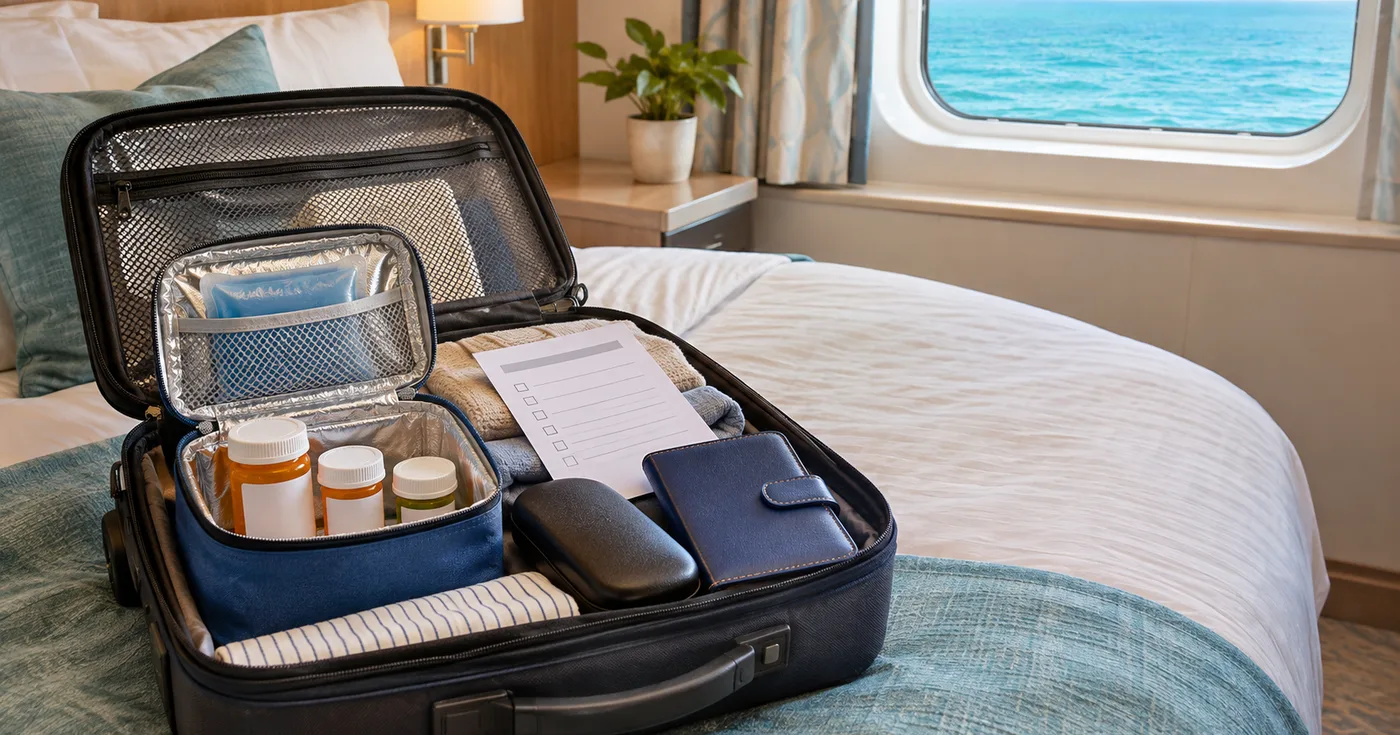
The suitcase can hold another swimsuit. A forgotten dinner outfit can be replaced near the port. Prescription medication is different: it is personal, sometimes temperature-sensitive, and not something a ship’s medical center or an island pharmacy can reliably reproduce.
Fortunately, bringing medicine on a Caribbean cruise is usually straightforward. The safest plan is built before embarkation, with the right supply, original packaging, documentation, and a clear understanding of what the ship and every country on the itinerary will allow.
Quick Take
You can bring prescription medication on a cruise. Keep it in your hand luggage, in original labeled containers, with enough for the full trip plus extra days for delays. Carry a prescription copy and a list using generic drug names. Confirm refrigeration before sailing, and check destination laws for controlled medicines. Medical marijuana and many CBD products remain prohibited by major cruise lines even when legal at home.
Pack Medicine for the Whole Journey, Not Only the Sailing
A seven-night cruise may be the centerpiece of the vacation, but the medication plan begins when you leave home. Flights, a pre-cruise hotel, embarkation, the voyage, and the trip home all count. Weather, airline disruptions, or an itinerary change can add days that were never on the original calendar.
Royal Caribbean and Celebrity tell guests to carry enough medication for the voyage plus several extra days. Carnival’s shipboard medical guidance and Norwegian’s medical-needs guidance go further, recommending ten extra days. Holland America advises an even larger two-week cushion in its pre-cruise information. Those are line recommendations, not permission to exceed a country’s legal personal-use limit, so controlled medicines need a more careful check.
Refill early enough to resolve an insurance quantity limit or contact the prescriber if the trip overlaps the next refill date. Keep the medicine where you can reach it during flights and embarkation. Cruise lines repeatedly warn against checked luggage because a bag can be delayed, misdirected, or inaccessible before cabins open.
Our Caribbean cruise packing list can organize the rest of the suitcase, but medication belongs with passports, travel documents, and other items that never leave your control.
Original Containers Make Border Questions Easier
TSA does not require pills to be in prescription bottles for airport screening, but that is only one part of an international trip. State laws, cruise-line guidance, customs rules, and destination laws can impose different expectations.
The U.S. Department of State’s current medicine guidance recommends original packaging, copies of prescriptions, and a clinician’s letter that lists the condition and each medicine by its generic name. The CDC’s international medication guidance similarly advises travelers not to decant medicine into an organizer before crossing borders.
That does not mean a daily organizer can never come along. It means the organizer should not be the only way to identify the pills. Carry the pharmacy-labeled containers and keep a printed or offline medication list showing the brand and generic name, strength, dosage, schedule, prescriber, pharmacy, allergies, and emergency contact. A photograph of each label adds a useful backup, but it should not replace required documentation.
For injectable medicine, controlled substances, or anything that could raise questions at security, ask the treating clinician for a concise signed letter. Keep needles and related supplies together with the labeled medication, and arrange a sharps container with the cruise line if needed.
A Caribbean Itinerary Crosses More Than One Rulebook
A prescription that is ordinary in the United States may be controlled, restricted, or prohibited somewhere else. The State Department specifically highlights medications such as certain ADHD drugs, sleeping medicines, narcotics, and medical marijuana. It advises checking with the embassy of every country visited or transited and warns that a U.S. prescription does not override foreign law.
That matters even if you do not plan to take the medicine ashore. The ship enters another country’s jurisdiction, port authorities can screen belongings, and an unexpected medical event may require you to disembark with the medication. Check the health and entry information for every scheduled country, not merely the embarkation port.
For a controlled medication, confirm the allowed quantity, documentation, and whether advance permission is required. Use the exact generic name when asking. If a country restricts a medicine you must take, speak with the prescriber and the appropriate embassy well before final payment; do not substitute or stop treatment without clinical guidance.
When returning to the United States, Customs and Border Protection says travelers must comply with FDA and DEA requirements. Controlled medicines should be declared, kept in original containers, limited to an appropriate personal-use amount, and supported by a prescription or physician statement.
Airport Screening and Cruise Embarkation Are Separate Checks
If you fly to the cruise, TSA allows pills and other solid medicine in screened baggage without the ordinary liquid-size limit. TSA’s medication guidance says medically necessary liquids do not have to fit inside the quart-size liquids bag, but the traveler should tell the officer about them at the start of screening. Additional inspection may be required.
Insulin, liquid medicine, ice packs, gel packs, and accessories should be grouped so they are easy to present. TSA strongly recommends carrying medicine rather than checking it. The cruise terminal then conducts its own security screening under the cruise line’s rules.
An airport officer allowing an item through does not guarantee that a ship or foreign port will accept it. Likewise, cruise-line permission does not settle airline handling. Keeping the official guidance and accommodation confirmation offline can help when internet service is unavailable.
Refrigeration Must Match the Medication, Not the Word “Fridge”
Cabin cooling equipment varies. Some units are beverage coolers, while others operate within a published refrigerator range. Whether either is suitable depends on the medication’s manufacturer instructions and the actual temperature—not the appliance’s appearance.
Princess says its stateroom refrigerators are generally kept around 37–45°F, with medical-center storage potentially available during open hours. Holland America publishes a similar cabin range and directs guests without a refrigerator to its accessibility team. By contrast, Carnival and Norwegian say cabin minibars are not suitable for temperature-sensitive medicine; both describe limited medical-center storage and allow a small personal medical cooler within their stated dimensions.
Contact the cruise line’s accessibility or medical-needs team before sailing. Provide the medication’s required temperature range, the ship, sail date, booking number, and whether access is needed outside clinic hours. Ask whether a medical refrigerator, cabin unit, cooler, sharps container, or other accommodation will be available, then save the written answer.
If flying, confirm how long the medicine may remain in an insulated carrier and what cooling method the manufacturer permits. Do not place medication directly against frozen packs unless its instructions allow that; freezing can be just as damaging as heat.
Medical Marijuana and CBD Are Not Ordinary Prescriptions at Sea
Legal at home does not mean permitted onboard. Royal Caribbean’s conduct policy prohibits marijuana even for medical purposes. Carnival’s policy prohibits medical marijuana and cannabis derivatives including CBD items. Norwegian’s prohibited-items list includes medically prescribed marijuana and products containing CBD or THC.
Do not pack gummies, oils, creams, or other cannabis-derived products because they seem less obvious than the plant itself. Denied boarding, confiscation, removal from the ship, or referral to authorities can be far more serious than losing the item. Travelers who rely on a cannabis-derived treatment should discuss lawful alternatives with their clinician before the trip.
Do Not Build the Plan Around an Emergency Refill
Ship medical centers can treat many routine illnesses and stabilize emergencies, but they are not floating versions of your neighborhood pharmacy. The CDC’s cruise-health guidance notes that shipboard capabilities vary and that medical care, testing, and medication generally cost extra.
Carnival, Norwegian, and Princess each say their formularies are limited and an exact replacement or dosage is not guaranteed. A ship’s physician may be able to offer an available alternative or help contact a port pharmacy, but consultation and medication charges can be added to the onboard account.
Buying medicine ashore brings another risk. The CDC warns that counterfeit or substandard products can appear even in pharmacies abroad. Cruise lines similarly caution against open-air markets and unverified sellers. If medicine is lost or damaged, start with the ship’s medical team, insurer assistance line, and the prescribing clinician rather than shopping independently.
This is also where Caribbean cruise travel insurance deserves a careful look. Coverage for medical care, replacement medication, interruption, or evacuation depends on the specific policy, and travelers may have to pay first and seek reimbursement later.
A Calm Embarkation Starts With a Small Medication File
The best medication kit is not elaborate. It is complete, identifiable, and easy to reach: original containers, the full trip supply plus an appropriate delay cushion, prescription copies, a medication list, a clinician’s letter when useful, refrigeration confirmation, and the emergency contacts you would need if plans changed.
Review everything again shortly before departure because cruise-line and destination rules can change. Discuss dosing across time zones, temperature tolerances, and any treatment decisions with the prescribing clinician or pharmacist. The cruise line can explain storage and security policies, but it cannot provide personal medical advice.
If you would like help choosing a Caribbean sailing around accessibility, timing, insurance, or other practical needs, tell CPosey Travel what matters for your trip. We can help compare the ships, ports, and travel arrangements while you and your medical team handle the care plan.
Frequently Asked Questions
Can you bring prescription medication on a cruise?
Yes. Bring enough for the entire trip plus a delay cushion, keep it in your hand luggage, and use the original labeled pharmacy container. Carry a prescription copy or medication list, and check each destination's rules for controlled or restricted drugs.
Do prescription medications have to be in their original bottles on a cruise?
Cruise lines and U.S. travel authorities strongly recommend original labeled containers. They make the medication, patient, dosage, and prescriber easier to verify. A pill organizer may be convenient onboard, but do not rely on it as the only packaging when crossing borders.
Can refrigerated medication be stored in a cruise cabin refrigerator?
It depends on the cruise line, ship, and medication's required temperature range. Some lines say cabin refrigerators are suitable within stated ranges; others warn that minibars are not medical refrigerators. Confirm arrangements before sailing and do not assume the cabin cooler is adequate.
Can you bring medical marijuana or CBD on a cruise?
Do not assume so. Major cruise lines including Royal Caribbean, Carnival, and Norwegian prohibit marijuana even when medically authorized, and Carnival and Norwegian expressly prohibit CBD products. The rules of every country and port also apply.
Can a cruise ship replace a lost prescription?
Possibly, but never count on it. Ship medical centers carry limited formularies, exact brands and dosages may be unavailable, and port pharmacies cannot guarantee a safe or legal replacement. Carry essential medicine with you and pack extra for delays.