
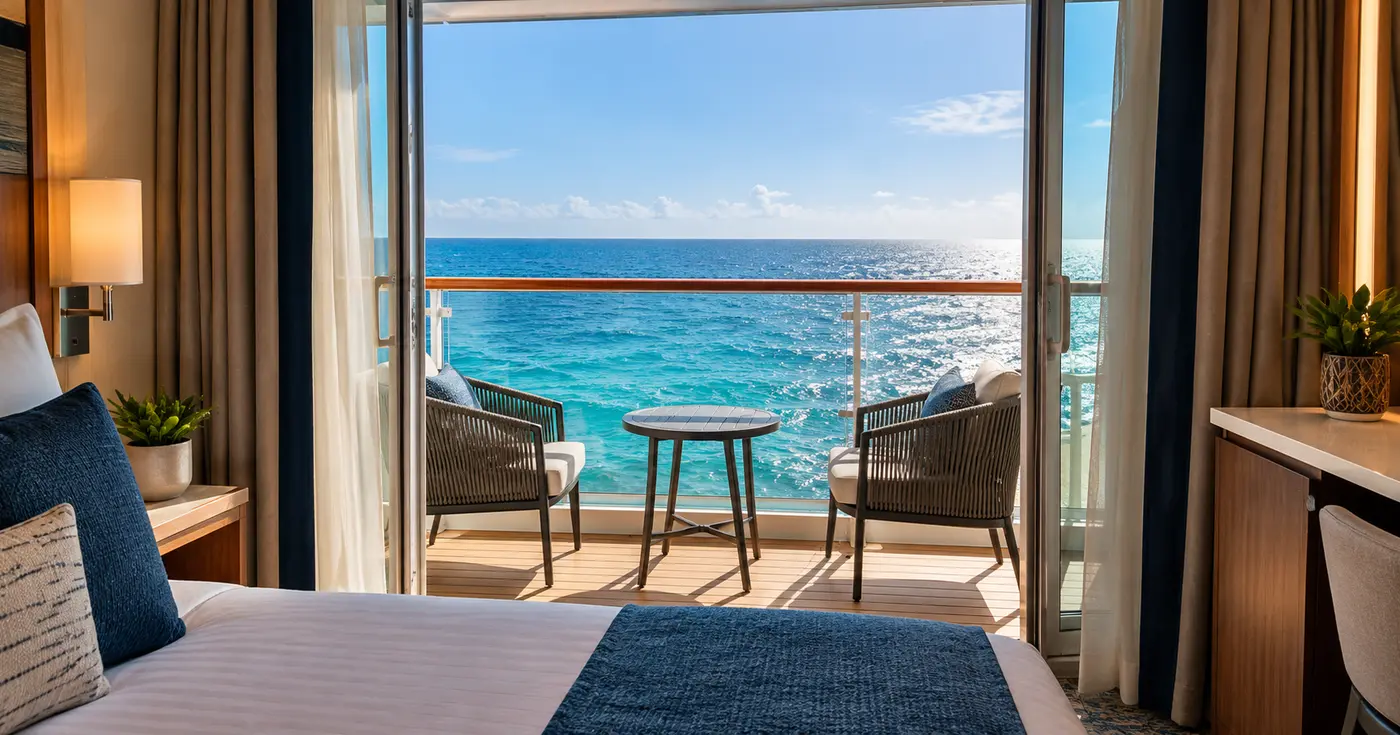
The ship is gliding toward a new island, the shoreline is beginning to take shape, and you have not yet stepped into a hallway or joined a crowd. You simply slide open the door, settle into a chair, and watch the Caribbean morning arrive.
That is the dream behind a balcony cabin—and sometimes it is every bit as lovely as it sounds. But a balcony is also one of the easiest cruise upgrades to romanticize before asking how you will actually spend your vacation. The better question is not whether balconies are wonderful. It is whether one will be wonderful for you.
Quick Take
For many Caribbean travelers, a balcony is worth it when the itinerary includes sea days, scenic arrivals, or you genuinely value private outdoor time. It may not be the best use of money on a port-heavy sailing or when the upgrade would replace excursions, airfare, or another priority. Compare the total upgrade—not just the daily price—and verify whether the category is ocean-facing, obstructed, guaranteed, or a different balcony design.
What You Are Really Buying
A balcony cabin is not simply a larger room with a patch of outdoor floor. Its real value is access: a quiet view before breakfast, fresh air while getting ready for dinner, and a place to linger after a full day ashore. You can check the weather without leaving your cabin. One person can read outside while the other sleeps. A room-service coffee can feel like an event instead of a beverage.
That access matters most to travelers who enjoy unhurried moments. If you already picture yourself sitting outside at sunrise or watching the wake at dusk, a balcony gives those moments a private address. Couples may appreciate having a second small living space, and families can gain a little breathing room when everyone is awake—although adults should always supervise children and follow the ship’s balcony safety rules.
Privacy is relative. Dividers separate most balconies, but neighbors may still be audible and crew may occasionally need exterior access. Wind, heat, salt spray, rain, and direct sun can also decide whether a balcony is inviting at a particular hour. It is private outdoor space, not a sealed retreat from the rest of the ship.
When a Balcony Usually Feels Worth It
Your sailing has meaningful time at sea
Sea days give you more opportunities to use the space without choosing between your balcony and a port you traveled hundreds of miles to see. A balcony can also shine on itineraries with later arrivals, scenic sail-ins, or an overnight port call. Even then, check the route rather than assuming every arrival will pass postcard scenery on your side of the ship.
Quiet time is part of your vacation
Some travelers want every waterslide, show, trivia game, and late-night venue. Others want a little Caribbean blue with no schedule attached. If solitude is one of the things you are paying to enjoy, a balcony may be more than a cabin upgrade—it may be part of the vacation itself.
It can be especially valuable when travel companions have different rhythms. An early riser gets somewhere to go without turning on every cabin light. A night owl can ease into the morning while someone else is already outside with a book.
You enjoy the cabin as more than a place to sleep
Think honestly about past trips. Do you linger over coffee in a hotel room, return for an afternoon break, or enjoy getting ready slowly? You are more likely to use a balcony. If your room is usually a launchpad and a bed, the extra money may buy more happiness elsewhere.
When You May Be Happier Saving the Money
A balcony is less compelling on a port-intensive itinerary when you plan to leave early, return late, eat out, and spend evenings around the ship. That is common on Southern Caribbean routes with several islands in succession, but it can happen anywhere. If the balcony will be empty for most daylight hours, an ocean-view or interior cabin may be the smarter fit.
The same is true when the upgrade competes with a priority you value more. A memorable shore day, convenient flights, a pre-cruise hotel, specialty dining, or simply keeping the trip comfortable for your budget can matter more than your cabin category. An interior cabin is not a lesser vacation if it allows you to take the vacation you actually want.
Light-sensitive sleepers may even prefer an interior room’s darkness. Travelers booking two cabins for a family should also compare the total difference across both rooms; a modest-looking per-person premium can multiply quickly.
If you are still choosing the sailing itself, start with our first Caribbean cruise guide. The right ship, pace, and itinerary usually affect your experience more than the view from your cabin.
Not Every “Balcony” Means the Same Thing
This is where a little careful reading protects both your expectations and your budget.
Traditional ocean-view balconies
This is the familiar arrangement: a cabin with a door to a private, open-air space facing the ocean. Size, furniture, overhang, and sightlines vary by ship and location. Some balconies are deeper or angled; others look past lifeboats, structural beams, or equipment. Deck plans and the exact category description matter more than the marketing photo.
Norwegian Cruise Line, for example, describes the balcony staterooms on Norwegian Prima as having floor-to-ceiling glass doors to a private balcony, while noting that some accessible balcony cabins are partially obstructed. That fine print is exactly why the category code deserves a second look.
Guarantee and obstructed-view categories
A “guarantee” booking usually promises a minimum category, not a cabin you select. You may receive an appealing assignment—but you are giving the cruise line control over location and specific features. Royal Caribbean says a guarantee stateroom can be assigned up to embarkation and may have an obstructed view. On Oasis- and Icon-class ships, its guarantee balcony guidance also says the assignment could be a neighborhood-view balcony overlooking areas such as Central Park, Boardwalk, or Surfside rather than the ocean.
That can be a fun choice when the ship itself is the scenery. It is not the same product as a quiet ocean-facing balcony, so the savings only count if you would be happy with the possible outcome.
Cove balconies
On ships that offer them, cove balconies sit lower and closer to the waterline, with more of the ship’s structure around the opening. Carnival’s Panorama stateroom guide describes its Cove Balcony as being closer to the water than other balcony rooms. Travelers may love that sheltered, near-the-sea feeling; others may prefer the openness and higher vantage point of a standard balcony.
Infinite verandas
An Infinite Veranda is not a conventional step-out balcony. Celebrity describes its design as bringing the veranda into the room, with the outside edge opening at the touch of a button. On Celebrity Apex, the cruise line lists an Edge Stateroom with Infinite Veranda at 243 square feet total, including a 42-square-foot veranda area.
Some travelers love the extra-feeling interior space and wide glass view. Others specifically want to walk outside and close a door behind them. Neither preference is wrong—but booking one while imagining the other is an expensive misunderstanding.
Let the Itinerary Help Decide
On a Caribbean cruise, the route changes the balcony calculation.
An Eastern Caribbean sailing may include broad beach days and a mix of sea time, while a Western route can lean toward active port adventures. The actual schedule matters more than the label, so compare the number of sea days, port arrival times, and how long you expect to be ashore. Our Eastern vs. Western Caribbean guide can help you choose the rhythm that fits before you choose the room.
Also consider the season and your own comfort. Caribbean afternoons can be hot, and a covered balcony may be more usable than a fully exposed one. Wind can be stronger when the ship is moving. If motion is a concern, do not assume a balcony solves it: cabin location also matters. The CDC’s motion-sickness guidance notes that viewing the horizon can help and recommends avoiding areas of maximum motion. A lower, more central cabin may feel steadier than a balcony high and far forward or aft.
A Simple Way to Price the Upgrade
Ignore the tempting “only a little more per day” framing for a moment. Compare the final price of the exact balcony you would book with the final price of the best alternative you would genuinely accept. Include every traveler in the cabin and the entire sailing.
Then ask three questions:
- What is the total upgrade, not the advertised starting difference?
- How many days and evenings are we realistically likely to use the balcony?
- What would we give up to pay for it?
If the premium feels comfortable and you can name the moments you are excited to spend there, the upgrade has a strong case. If you keep trying to justify it with resale language—“better,” “more luxurious,” “what people are supposed to book”—save the money without guilt.
Before paying, verify the exact category, deck, occupancy, bed arrangement, obstruction, connecting door, nearby public spaces, and whether the balcony faces the ocean or an interior neighborhood. Check what is directly above and below the cabin, too. A beautiful view does not cancel out early chair movement from the pool deck overhead.
So, Is the Balcony Worth It?
Yes—for travelers who will use it as a favorite place, not merely admire it during the cabin tour. A balcony is often a joyful upgrade on a relaxed Caribbean sailing with sea days, scenic approaches, or a strong desire for private outdoor time.
But it is not a requirement for a wonderful cruise. If you would rather turn the price difference into an island experience, a longer trip, easier travel days, or room in the budget to breathe, choose the simpler cabin and step onto the open decks whenever you want the horizon.
The best cabin is the one that supports the vacation you want once the door closes behind you. Tell CPosey Travel what you picture for your Caribbean escape, and we will help you compare ships, cabin designs, and itineraries without losing sight of the moments that matter most.