
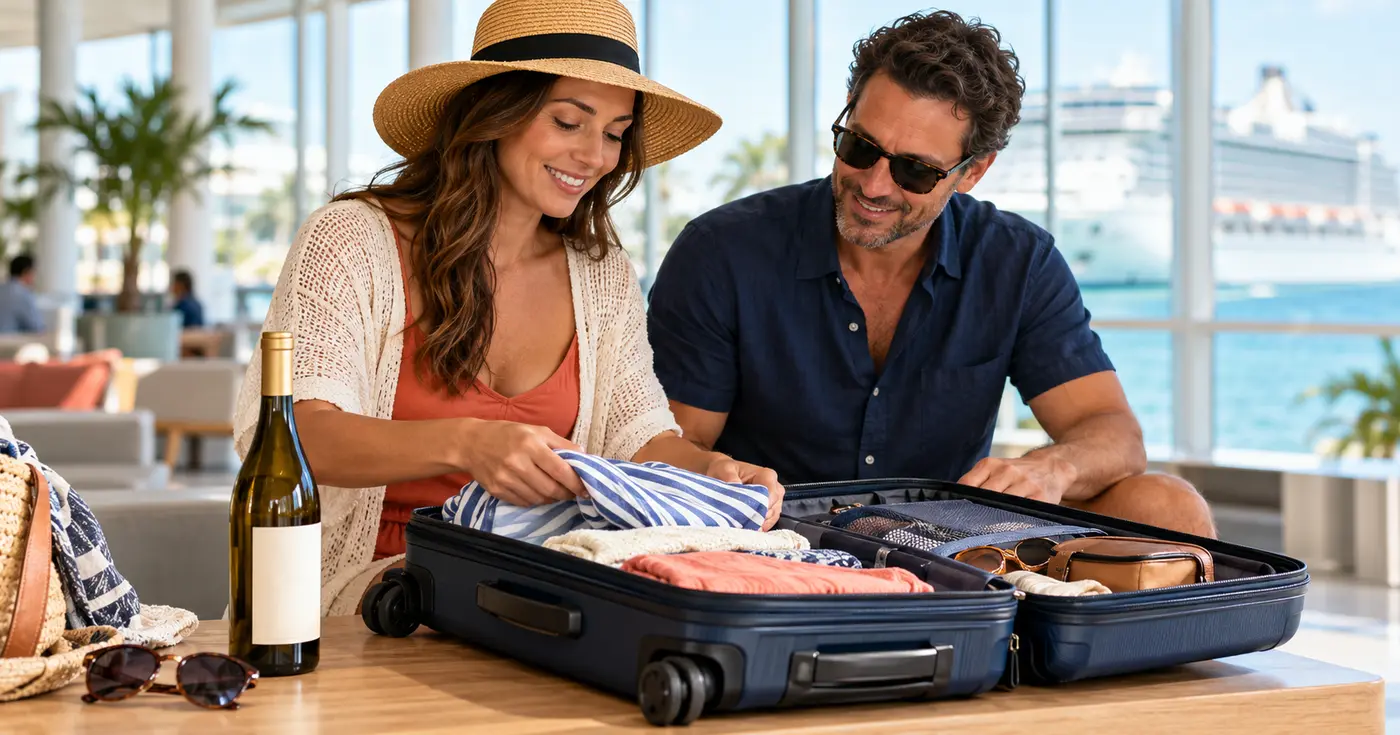
A favorite bottle can feel like a small piece of the vacation: something saved for sailaway on the balcony, an anniversary toast, or one quiet evening after a full day in port. Then the packing question arrives. Does that bottle belong in the carry-on, the checked suitcase, or back on the kitchen counter?
So, can you bring alcohol on a cruise? The answer depends less on the Caribbean itinerary than on the cruise line printed on your booking.
Quick Take
Yes, several cruise lines let adults bring a limited amount of wine or champagne on embarkation day, usually in a carry-on. The allowance, bottle limit, corkage fee, and permitted beverage vary by line. Beer and spirits are usually prohibited, though Disney allows a beer alternative. MSC prohibits personal alcohol entirely. Always recheck your cruise line’s current policy before packing.
The Rule Is About Your Cruise Line, Not the Island
There is no single Caribbean cruise alcohol policy. Royal Caribbean, Carnival, Princess, Celebrity, Norwegian, Disney, and MSC each set their own rules, and similar-looking policies can hide important differences.
One line may allow one bottle per adult with no fee in the stateroom. Another may charge a corkage fee wherever the bottle is opened. A third may allow wine but no personal alcohol at all. The rules can also distinguish wine from fortified wine, a standard 750 ml bottle from a magnum, and embarkation-day alcohol from bottles purchased later in port.
Think of the allowance as a narrow exception—not permission to pack a personal bar. The safest plan is to use the original sealed container, stay within the exact size and quantity limit, and keep permitted bottles in your carry-on when the line instructs you to do so.
Royal Caribbean: One Bottle per Guest of Drinking Age
Royal Caribbean currently allows each guest of drinking age to carry on one sealed 750 ml bottle of wine or champagne on embarkation day. Boxed wine and other containers are not permitted. Beer, hard seltzer, and liquor do not qualify for the exception.
Personal wine or champagne consumed in a public area is subject to a $15 corkage fee per bottle. A bottle enjoyed privately in the stateroom does not fall under that public-area fee language.
This is a per-person allowance, not simply one bottle per cabin. On a North American sailing, the guest carrying the bottle must be old enough under the line’s drinking-age policy. If you are sailing back-to-back cruises, Royal Caribbean permits one bottle for each sailing and asks guests carrying the future sailing’s bottle to have consecutive-cruise documentation available.
Carnival: One Bottle, Carry-On Only, With an ABV Limit
Carnival permits guests age 21 and older to bring one sealed 750 ml bottle of wine or champagne per person at the beginning of a U.S.-departure cruise. It must be in carry-on luggage. Beer and hard liquor are prohibited.
Carnival adds a detail that is easy to miss: port, vermouth, sherry, and other fortified wines over 15% alcohol by volume are not allowed under the wine exception. A standard-looking bottle can therefore be rejected if the contents fall outside the policy.
If Carnival serves the bottle in a main dining room, specialty restaurant, or bar, the line lists a $15 corkage fee per 750 ml bottle. Keep the receipt and the bottle’s label easy to inspect; trying to disguise alcohol as another beverage is far more likely to delay the start of the trip than to save money.
Norwegian: Wine Is Allowed, but Corkage Works Differently
Norwegian Cruise Line allows guests to bring wine and champagne onboard, while other personal alcohol is prohibited. Its current wine and champagne policy lists a $15 corkage fee for a 750 ml bottle and $30 for a 1,500 ml magnum.
The notable difference is where the fee applies. Norwegian says the charge applies when the bottle is served or consumed in a restaurant, public room, or stateroom. Guests with a qualifying beverage package—including one received through Free at Sea—are not charged that corkage fee under the published policy.
Norwegian’s FAQ does not state a simple one-bottle-per-adult limit like Royal Caribbean or Carnival. That should not be read as an invitation to bring an unreasonable quantity. Confirm the current rule on your booked sailing and compare the total corkage expense with the convenience of buying wine onboard.
Princess: One Stateroom Bottle Without Corkage, Then a Fee
Princess permits one 750 ml bottle of wine or champagne per guest, per voyage. According to its current pre-cruise alcohol guidance, that first bottle is not subject to corkage when consumed in the stateroom.
Additional wine or champagne bottles are allowed, but Princess lists a US$20 corkage fee for each additional bottle on ships using U.S. dollars. The fee applies regardless of where the extra bottle will be consumed. Beer, liquor, and spirits are not permitted as personal embarkation alcohol.
This policy can work nicely for a traveler who wants one special bottle in the room. It also makes the cost of bringing several bottles easy to underestimate: the purchase price at home is only part of the calculation once the additional-bottle fees begin.
Celebrity: One Bottle per Adult and a Higher Public-Area Fee
Celebrity allows one 750 ml bottle of personal wine per guest of drinking age, packed in a carry-on rather than checked luggage. Its current FAQ lists a $35 corkage fee when the bottle is consumed in a restaurant, bar, or other dining venue.
Celebrity waives that public-area corkage fee for guests with a Classic or Premium Beverage Package. If you already have a package, bringing a sentimental or hard-to-find bottle may still make sense. If the goal is simply to save money on an ordinary glass of wine, compare the bottle price and any applicable fee with what your package already covers.
Disney: Wine or Beer, but Not Both
Disney Cruise Line stands apart because it offers a beer alternative. Guests age 21 and older on most sailings may bring either one unopened bottle of wine or sparkling wine up to 750 ml, or six unopened beers up to 12 ounces each at the beginning of the voyage. The alcohol must be in carry-on luggage.
Disney lists a $20 corkage fee for a personal bottle served in a dining room. Alcohol brought onboard may not be consumed in lounges or other public areas. The line also prohibits partially used bottles and says excess quantities must be discarded before entry, with no compensation.
For families traveling with several adults, remember that the allowance belongs only to guests who meet Disney’s drinking-age rule. Do not use a child’s luggage to spread out adult alcohol.
MSC: Leave Personal Alcohol at Home
MSC Cruises’ U.S. guidance is the clearest kind of rule: guests may not bring alcoholic beverages onboard. That prohibition includes wine, beer, and spirits; there is no standard embarkation-day wine exception in the published U.S. luggage policy.
If your vacation includes MSC, plan to purchase beverages through the ship rather than carrying a bottle from home. This is also a good reminder not to assume that a policy used by one major cruise line will carry over to another, even when both ships leave from the same Florida port on the same weekend.
Why Your Wine Belongs in the Carry-On
Where a line permits embarkation alcohol, the carry-on is generally the right place for it—and Carnival, Celebrity, and Disney explicitly require that placement. Security can inspect the sealed bottle while you are present, and you avoid sending glass through the checked-luggage handling process.
Wrap the bottle for ordinary protection, but keep the label and seal accessible. A padded bottle sleeve can help contain a break. Do not transfer wine to another container, open it before boarding, or tuck it inside a water bottle. Concealed alcohol can be discarded, and a policy violation can create a much larger problem than a corkage charge.
If you are flying to the cruise port, airport security and ship security are two separate checkpoints. TSA permits only containers of 3.4 ounces or less through the standard passenger screening lane in a carry-on, so a full wine bottle generally needs to travel in checked airline baggage until you reach the cruise city. TSA’s current alcoholic-beverage guidance also places limits on higher-proof alcohol in checked bags. Move a cruise-permitted bottle to your carry-on after the flight and before arriving at the terminal.
Our Caribbean cruise packing list can help you separate embarkation-day essentials from items that can wait in checked luggage.
What Happens to Alcohol Bought in Port?
A bottle of rum from a distillery tour or wine from an onboard duty-free shop is usually treated differently from an embarkation-day allowance. The major lines covered here generally collect those purchases when you return to the ship and release them near the end of the cruise. In other words, a bottle purchased in Cozumel or St. Thomas is typically a souvenir for home, not the evening’s cabin drink.
Present the purchase to security when reboarding and keep the claim information the ship provides. Pickup timing and location can vary, so read the instructions rather than waiting until the final rush to ask where the bottle went.
You must also declare foreign purchases when returning to the United States. U.S. Customs and Border Protection explains that one liter of alcohol may generally be included in a returning resident’s duty-free personal allowance when the traveler is at least 21 and other conditions are met. State limits can be more restrictive, and quantities beyond the exemption can be dutiable. When in doubt, declare the purchase.
Is Bringing a Bottle Actually Worth It?
It can be. A permitted bottle makes the most sense when it is meaningful, difficult to replace onboard, or intended for a quiet stateroom occasion. It can also be a modest way to control costs when the line does not charge for in-room consumption.
The value becomes less obvious when a corkage fee applies everywhere, a beverage package already covers the drinks you want, or the bottle must survive a flight and hotel stay before embarkation. Convenience matters too. Saving a few dollars is not much of a victory if the bottle complicates every transfer on the way to the ship.
Before buying a drink package, compare the line’s current daily price, package rules, included beverages, port-day habits, and every adult’s expected use. Our guide to the real cost of a Caribbean cruise explains how beverage spending fits into the larger vacation budget.
Check Once More Before You Zip the Bag
Cruise alcohol policies can change, and a special sailing, charter, departure country, or local rule can affect the standard guidance. Reopen the official policy for your cruise line a few days before travel. Confirm the number of bottles, container size, permitted beverage, age requirement, luggage placement, and corkage fee.
Then photograph the bottle and its label, pack it where security expects to find it, and let the rule become one less uncertainty on embarkation morning.
If you would like help comparing beverage packages, cabin choices, and the fine print that shapes the final price, tell CPosey Travel what you are planning. We can help you sort through the details before your suitcase is closed and your vacation begins.
Frequently Asked Questions
Can you bring alcohol on a cruise?
Partly. Most major cruise lines allow a limited amount of wine or champagne at embarkation — commonly one 750 ml bottle per guest of drinking age. Beer and spirits from home are generally prohibited and will be held or discarded.
Is there a corkage fee if you bring your own wine?
If you drink your bottle in a dining room, most lines charge a corkage fee — currently about $15 to $35 per bottle depending on the line. Drinking it in your stateroom avoids the fee on the lines that allow carry-on wine.
Where should you pack the wine you bring?
In your carry-on, always. Bottles in checked luggage are screened and removed, and a broken bottle in a suitcase is a miserable start to a vacation.
What happens to duty-free alcohol you buy in port?
The ship holds it for you and returns it on the last night of the cruise. That is standard practice across the major lines — it is not confiscation.
Can you bring beer or liquor instead of wine?
On the major lines, no. The embarkation exception covers wine and champagne only; beer and spirits are prohibited and will not be returned until the end of the cruise, if at all.