
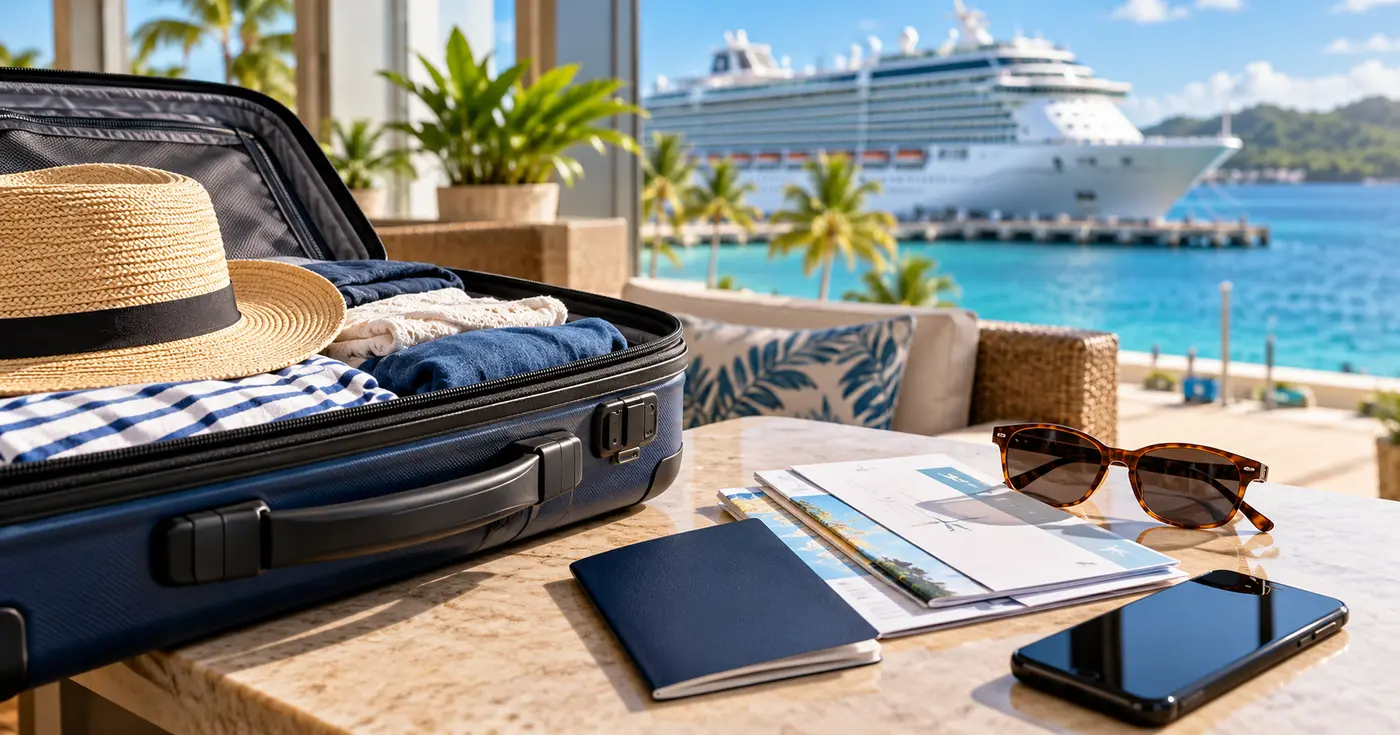
The suitcase is open, the excursions are chosen, and the Caribbean is beginning to feel wonderfully close. Then one small question suddenly carries the weight of the entire vacation: Do you need a passport for this cruise?
For some U.S. citizens on certain round-trip sailings from the United States, the technical answer may be no. But the complete answer depends on the exact itinerary, every traveler’s citizenship, the documents each port accepts, and the cruise line’s current boarding rules. This is one detail worth settling before the final payment—not while standing at the terminal.
Quick Take
U.S. citizens on an eligible closed-loop Caribbean cruise—one that begins and ends at the same U.S. port—may be allowed to travel with approved proof of citizenship plus government-issued photo identification instead of a passport. That exception is not universal, and destination or cruise-line rules can still require a passport. A valid passport book remains the safest choice because it also allows international air travel if an emergency interrupts the cruise.
The Closed-Loop Rule Is the Starting Point
A closed-loop cruise begins and ends at the same U.S. port and travels within the Western Hemisphere. A sailing that leaves Miami, visits Caribbean islands, and returns to Miami may qualify. A cruise that starts in one port and ends in another—even if both ports are in the United States—is not the same thing.
U.S. Customs and Border Protection explains that eligible U.S. citizens on closed-loop cruises may be able to depart and reenter with acceptable proof of citizenship rather than a passport. Travelers age 16 or older also need an accepted government-issued photo ID. Children have different photo-identification rules, but they still need qualifying citizenship documents.
The phrase may be able to matters. The U.S. reentry exception does not erase the entry rules of the countries on the itinerary, and a cruise line can require more documentation than the minimum CBP rule. If one destination requires a passport, the line may require it at embarkation even though the ship returns to the same U.S. port.
That is why the answer cannot come from the departure port alone. It must come from the complete itinerary and the cruise line’s instructions for the exact sailing.
When a Passport Book Is Required
A valid passport book is generally required when a U.S. citizen takes a cruise that is not closed-loop, begins outside the United States, ends in a different port, or includes travel that requires international flights. Some destination-specific itineraries also require a passport even when the ship returns to the same U.S. homeport.
Norwegian’s current travel-document guidance, for example, requires a valid passport on sailings that begin in one U.S. port and end in another. It limits its alternative-document option to qualifying round trips that begin and end at the same U.S. port and do not pass through the Panama Canal or visit South American ports. Other cruise lines and itineraries may draw their boundaries differently.
International embarkation adds another layer. If the cruise begins in San Juan, Puerto Rico, a U.S. traveler is not taking an international flight merely to reach the port. If it begins in Barbados, however, the traveler must meet international air-entry requirements before ever reaching the ship. A one-way or repositioning cruise can also turn what looks like a familiar Caribbean vacation into a passport-required itinerary.
When in doubt, look at the city printed beside both embarkation and disembarkation, then read every port on the itinerary. The word round trip is more useful than assuming every cruise from a U.S. website follows the same rules.
What Can Replace a Passport on an Eligible Cruise?
For a qualifying U.S. citizen, acceptable proof of citizenship may include a government-issued birth certificate from a state vital-records office, a Consular Report of Birth Abroad, a naturalization or citizenship certificate, a U.S. passport card, or an Enhanced Driver’s License. The exact list and document format depend on the line and itinerary.
A standard driver’s license—even one marked REAL ID—is proof of identity, not proof of U.S. citizenship. On a birth-certificate sailing, an adult normally needs both parts: the approved citizenship document and an accepted government-issued photo ID. An Enhanced Driver’s License is a separate document available only from certain states and is designed for land and sea border crossings.
Do not assume a phone photo, ordinary photocopy, hospital souvenir certificate, baptismal record, voter-registration card, or Social Security card will work. Royal Caribbean’s travel-document page tells guests using a birth certificate to bring an original state-certified document or certified copy. Norwegian currently states that pictures and photocopies are not accepted under its proof-of-citizenship option. The safest approach is to follow the stricter instruction attached to your actual reservation.
Names deserve attention too. If the name on a citizenship document differs from the booking and photo ID because of marriage, divorce, adoption, or another legal change, ask the cruise line which linking document it requires. Matching the reservation to the travel documents before final payment is much easier than trying to explain a discrepancy on embarkation morning.
A Passport Card Is Useful—but It Is Not a Passport Book
A U.S. passport card can be convenient for eligible land and sea travel from Canada, Mexico, Bermuda, and the Caribbean. It fits in a wallet and may satisfy documentation rules for some closed-loop cruises.
Its important limitation appears when the plan changes: a passport card is not valid for international air travel. If illness, injury, a missed departure, or another emergency leaves you in a foreign country after the ship sails, the card does not give you the same route home as a passport book.
The U.S. Department of State’s cruise guidance strongly recommends that cruise passengers carry a passport book even when it is not required. The reason is practical, not bureaucratic. A medical evacuation, family emergency, mechanical problem, or missed ship can suddenly turn a sea journey into an international flight.
The Emergency Question Changes the Decision
Imagine a perfectly ordinary port day. A traveler becomes ill, is admitted to a local hospital, and cannot return before the ship departs. Or a delayed independent excursion reaches the pier after the gangway is gone. The vacation is no longer following the closed-loop itinerary that made alternative documents possible.
A passport book will not prevent the disruption, but it gives the traveler the document normally required to board an international flight back to the United States. Without one, the traveler may need emergency assistance from a U.S. embassy or consulate before flying. That can add time, expense, and stress to an already difficult situation.
For many travelers, that flexibility is the strongest reason to obtain a passport even when the cruise can legally be taken without it. The decision is not only about getting onto the ship. It is about preserving options after the ship leaves the first port.
Children, Permanent Residents, and Non-U.S. Citizens Need Their Own Review
Do not treat one adult traveler’s answer as the answer for the entire cabin. Infants and children need their own citizenship documents, and age affects photo-ID requirements. CBP says U.S. citizens under 16 on qualifying closed-loop cruises may present specified citizenship evidence without the adult photo-ID combination, but the cruise line’s instructions still control what it will accept at boarding.
Lawful permanent residents should carry a valid Permanent Resident Card and confirm the passport and visa rules of every destination. A country that admits a U.S. citizen without a passport may apply different rules to a resident traveling on another nationality’s passport.
Non-U.S. citizens must review their passport, visa, ESTA, U.S. reentry status, and destination-country requirements. The closed-loop exception often discussed in cruise advertising is a U.S.-citizen rule, not a universal permission to sail without a passport. When a cabin includes more than one citizenship or immigration status, verify each person separately.
Check the Documents Before You Commit to the Fare
The best time to solve the passport question is while comparing sailings. Before paying a nonrefundable deposit, confirm:
- where the cruise begins and ends;
- every country and territory on the itinerary;
- the cruise line’s document list for that sailing;
- each traveler’s citizenship and residency status;
- passport expiration dates, names, blank pages, and visa requirements; and
- which original or certified documents must be brought to the terminal.
Do not rely solely on an old social-media post or a friend’s experience on a different ship. Government and cruise-line requirements can change, and two sailings from the same homeport may not have the same document rules.
Passport timing also belongs in the early planning conversation. As of October 18, 2026, the State Department lists routine passport processing at four to six weeks and expedited processing at two to three weeks, excluding mailing time. Those estimates can change, so check the official page before building a trip around them. The State Department also advises cruise travelers to have passports valid at least six months beyond their travel dates, while cruise lines may publish their own validity requirements.
Documents Are One Part of a Calm Embarkation
Once the paperwork is settled, the rest of the trip becomes much more enjoyable to plan. Our first Caribbean cruise guide walks through choosing the itinerary, ship, cabin, and trip length. If you are comparing the full budget, the guide to Caribbean cruise costs beyond the fare includes transportation, hotels, gratuities, insurance, and onboard extras.
Travelers leaving from Texas can also use the guide to cruising from Galveston for terminal, parking, and arrival-day planning. The documentation principle is the same from every homeport: verify the rules for the exact sailing rather than assuming last year’s answer still applies.
The Safest Answer Is Often the Simplest
Yes, an eligible U.S. citizen may be able to take a closed-loop Caribbean cruise without a passport book. That can make cruising more accessible for a family whose documents are current and whose itinerary clearly qualifies.
But if there is time to obtain one, a valid passport book is usually the more flexible travel document. It reduces the number of exceptions you must interpret, supports international air travel in an emergency, and travels with you beyond this one cruise.
Before booking, share the exact itinerary and traveler details with CPosey Travel. We can help identify the cruise line’s current document page and the government resources each traveler should review, so the vacation begins with anticipation—not uncertainty at the terminal.
Frequently Asked Questions
Do I need a passport for a Caribbean cruise?
Not always legally — but it is the document I recommend. U.S. citizens on a closed-loop cruise (one that starts and ends at the same U.S. port) can often sail with a certified birth certificate and a government photo ID. A passport covers every situation, including having to fly home early from a foreign port.
What is a closed-loop cruise?
A cruise that departs from and returns to the same U.S. homeport. Most Caribbean cruises from U.S. ports are closed-loop, which is why the birth-certificate option exists at all.
Can I use a passport card instead of a passport book?
A passport card works for returning to the U.S. by land or sea from nearby countries, including on a cruise — but it is not valid for international air travel. If anything goes wrong and you need to fly home, the card does not help.
How long does it take to get a passport?
As of October 2026, the State Department lists routine processing at four to six weeks and expedited at two to three weeks, plus mailing time. Check travel.state.gov for the current figures before you book — and apply earlier than you think you need to.
Do children need passports for a cruise?
Children under 16 can sail a closed-loop cruise with a birth certificate; travelers 16 and older also need a government photo ID. Many families get passports anyway for the same fly-home reason.