
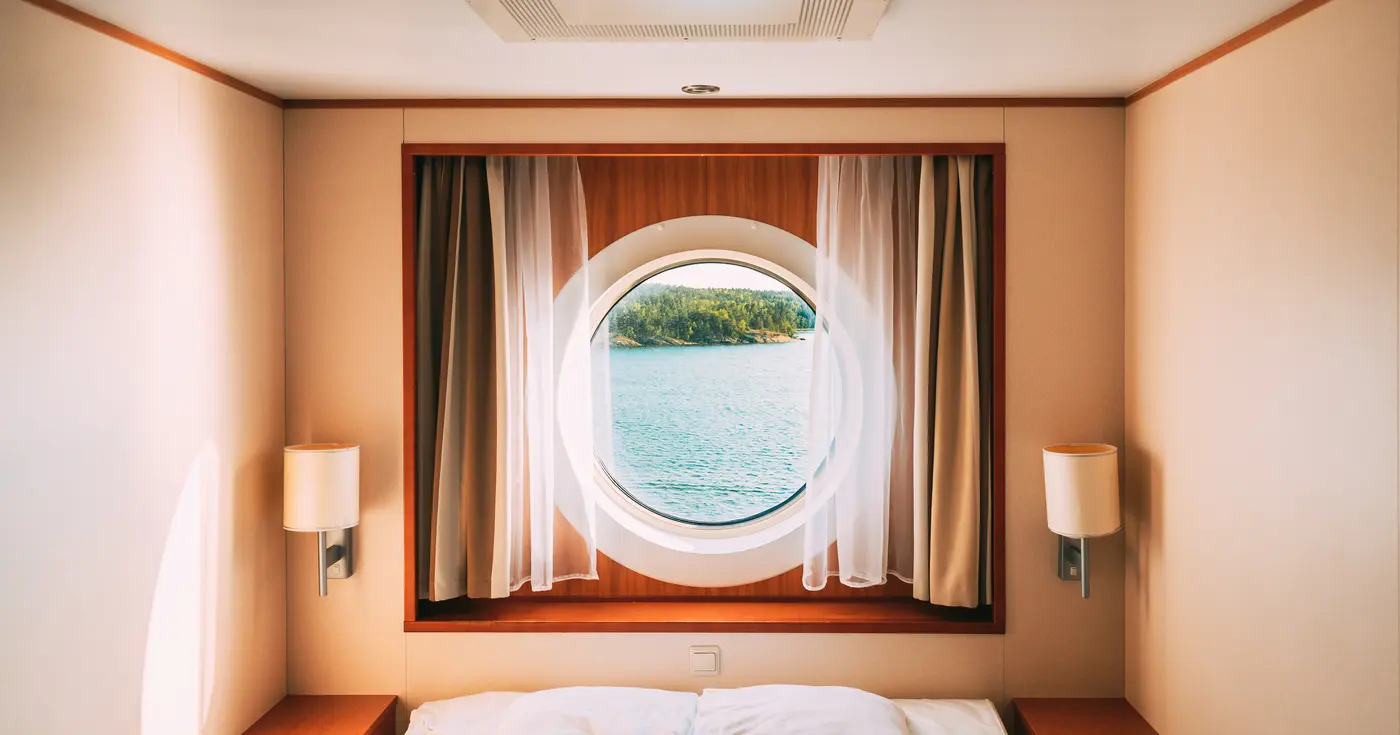
The cabin door closes, the ship eases away from the pier, and one booking decision becomes real: will you miss seeing the horizon from your room, or be delighted that the money stayed in your vacation budget?
That is the heart of the interior-versus-ocean-view choice. Both rooms can carry you to the same beaches, dining rooms, shows, and sunsets. The difference is how much the outside world matters during the hours you spend behind your own door.
Quick Take
Choose an interior cabin when the lower fare matters most, you sleep well in a dark room, and you expect to spend most of the day around the ship or ashore. Choose an ocean-view cabin when natural light, a look at the weather, and seeing the Caribbean from your room will improve the trip. Compare the exact cabins—not only the category names—because size, window style, location, and obstruction can vary.
The Real Difference Is the Window
An interior cabin has no window to the sea. An ocean-view cabin has a window or porthole, but no private outdoor space. In most other ways, the two categories may be more alike than their names suggest: both typically provide beds, a private bathroom, storage, a television, climate control, and daily stateroom service according to the cruise line’s current program.
Norwegian’s own cruise glossary makes the distinction especially clear: an Inside Stateroom has no window or porthole, while an Oceanview Stateroom has one. That glass changes the atmosphere more than the function. It can make the room feel brighter and more connected to the voyage, but it does not give you the fresh air, outdoor seating, or direct access to the sea that comes with a balcony.
Begin with your habits rather than a cabin-category ladder. An ocean-view room is better only when the light and view are worth more to you than the fare difference.
Why an Interior Cabin Can Be the Smart Choice
Interior cabins are usually the entry point to a ship, which can make them a practical way to protect the rest of the vacation budget. The savings may pay for a shore excursion, specialty dinner, pre-cruise hotel, flights, or simply make a longer sailing possible. Our guide to the real cost of a Caribbean cruise can help you compare the room upgrade with the expenses that arrive after the base fare.
Darkness is another advantage. With no sunrise slipping around the curtains, an inside room can be easy to sleep in after a late show or before an early port day. Travelers who use the cabin mainly to shower, change, and rest may gain little from paying for scenery.
An interior cabin can also open better location choices within the same budget. Instead of taking the least expensive ocean-view room at the far end of the ship, you may be able to choose an inside cabin near the middle, close to an elevator bank, or surrounded by other staterooms. If motion or noise matters, location can have more impact than the presence of a window. Use our cruise cabin location guide to compare the decks above and below before choosing.
Some people feel cocooned in a windowless room; others lose their sense of time or feel closed in. If spaces without daylight bother you, a weeklong cruise is not the place to test that feeling.
Why an Ocean-View Cabin May Be Worth It
An ocean-view cabin brings daylight into the room and keeps the journey visible. You can glance outside before getting dressed, see whether the ship has reached the pier, watch a coastline appear, or sit quietly while the water changes color. On a Caribbean sailing, that connection can be especially appealing when the itinerary includes scenic arrivals or a few unhurried sea mornings.
The view can also make a compact room feel less enclosed, even when the floor area is only modestly different. Royal Caribbean describes its Ocean View staterooms as a way to follow the scenery from shore to shore, while Carnival says its Ocean View rooms use a picture window to bring outside scenery into the cabin. Those are marketing descriptions, but they capture the practical value: the upgrade is mostly about light, orientation, and atmosphere.
Families may appreciate showing children where the ship is and whether it is morning without leaving the room. Daytime cabin users may enjoy the window more than someone who stays out from breakfast through bedtime. An ocean view can be a comfortable middle ground when an interior feels too enclosed but a balcony stretches the budget.
Still, a window is not a balcony. You generally cannot step outside, order breakfast to a private table in the ocean air, or photograph the view without glass between you and the water. If those are the experiences you are picturing, compare the actual upgrade to a balcony using our guide to whether a Caribbean cruise balcony is worth it.
Do Not Assume Ocean View Means More Space
Cabin size follows the ship and subcategory, not a universal hierarchy. Some ocean-view rooms are larger than nearby interiors, while others are close in size. Family, panoramic, accessible, and oddly shaped cabins can further blur the comparison.
Norwegian currently says its standard Oceanview Staterooms offer up to 161 square feet and some sleep as many as five guests, while Inside Staterooms offer up to 142 square feet and some sleep up to four. The line also notes that actual amenities vary by ship and category—and that Norwegian Epic has no Oceanview Staterooms. On MSC Poesia, MSC lists one Deluxe Interior example at approximately 151 square feet and a Deluxe Ocean View example at approximately 172 square feet, while warning that layouts and furniture may vary within a category.
Those examples are not rules for another ship. Royal Caribbean’s room collection includes interior and ocean-view categories for larger families, so a fleetwide maximum says little about a standard double-occupancy cabin. Open the exact ship’s deck plan and confirm square footage, occupancy, bed arrangement, and whether extra berths reduce usable floor space.
The Window May Not Be the View You Imagined
“Ocean view” covers more than one shape of glass. A room may have a round porthole, a larger picture window, a forward-facing window, or a window with a partial or full obstruction. Lifeboats, structural equipment, or the ship’s design can interrupt the view without removing the natural light.
Carnival, for example, lists an “Interior with Window (Obstructed View)” on Carnival Pride. That category demonstrates why the label alone is not enough: a cabin can be sold within the interior family yet still have daylight through glass, while the scene outside is restricted. Royal Caribbean also warns that guests who book a guarantee stateroom let the line assign the exact cabin and may receive an obstructed view.
Some modern interiors create a different kind of connection. On Symphony of the Seas, Royal Caribbean offers Interior rooms with a Virtual Balcony—a screen showing real-time exterior views—as well as interior rooms looking into Central Park or the Royal Promenade. These can make the room feel more open, but a screen or neighborhood window is not the same product as an exterior ocean-view window.
If the view is why you are paying more, choose the exact room when possible. Read the deck-plan symbols, look for obstruction language, and confirm whether photos represent that category or merely a similar room.
Let the Caribbean Itinerary Break the Tie
A port-intensive itinerary strengthens the case for an interior. If most mornings begin early and most afternoons are spent on beaches, boats, or walking tours, the cabin may receive little daylight use. You can keep the fare down and let the destinations provide the view.
Sea days change the calculation. A sailing with several days between ports gives you more opportunities to nap, read, order room service, or take a quiet break. Travelers who retreat from crowds may value an ocean-view cabin more on that itinerary, even without a balcony.
Arrival times matter too. If port calls begin early and your group sleeps until the alarm, the view may become a weather check. A traveler who wakes naturally with the light may love watching the first harbor appear.
Consider the season without treating the Caribbean as one uniform place. Day length, rain, wind, and sea conditions vary, and no cabin category guarantees postcard scenery. The decision is whether seeing whatever is outside—bright sun, gray sky, open water, or a working pier—helps you feel part of the voyage.
Which Cabin Fits Your Travel Style?
An interior cabin often fits travelers who are price-conscious, comfortable in small spaces, good sleepers, and happiest when the ship itself is the destination. It can also be the right compromise for a group booking multiple rooms, especially when keeping cabins close together matters more than the view.
An ocean-view cabin often fits first-time cruisers who worry about feeling enclosed, daytime cabin users, families who appreciate natural light, and travelers who enjoy seeing the ship’s progress. It can be particularly sensible when the price gap is small and the exact room has a clear, useful window.
Solo travelers should compare categories rather than assume one has the best single-occupancy value. Norwegian currently offers Solo Inside and Solo Oceanview options on eligible ships, with its official room page noting that traditional double-occupancy rates do not apply to those solo categories. Inventory and pricing vary, so the least expensive standard interior is not automatically the best solo fare.
Accessibility needs come before either view preference. An accessible cabin’s doorway, bathroom, turning space, bed approach, and location can matter far more than the window. Confirm the exact accessible category with the cruise line or your travel advisor rather than assuming that a larger-looking ocean-view room has the needed features.
Compare the Upgrade Against the Whole Vacation
Look at the total difference for the cabin—not merely the per-person headline. Then ask what that amount could change elsewhere. Would you trade the window for a memorable excursion? Would keeping the ocean view prevent you from worrying about the room for months? Neither answer is more sophisticated. The right value is the one that improves your trip.
Before booking, compare the two exact cabin numbers or the narrowest available categories. Check square footage, window type, obstruction, deck, nearby venues, occupancy, bed configuration, and cancellation terms. If one option is a guarantee rate, imagine receiving the least desirable eligible location. Book it only if the savings still feel worthwhile.
Choose the Room You Will Enjoy Using
An interior cabin is not a lesser Caribbean vacation, and an ocean-view cabin is not an unnecessary indulgence. One prioritizes access to the ship and destinations at a lower price. The other brings daylight and the passing world into your private space.
If you are still comparing cabins, tell CPosey Travel what matters most to your group—budget, quiet, motion, natural light, location, or room to spread out. We can help you look beyond the category label and choose the cabin that fits the way you actually travel.