
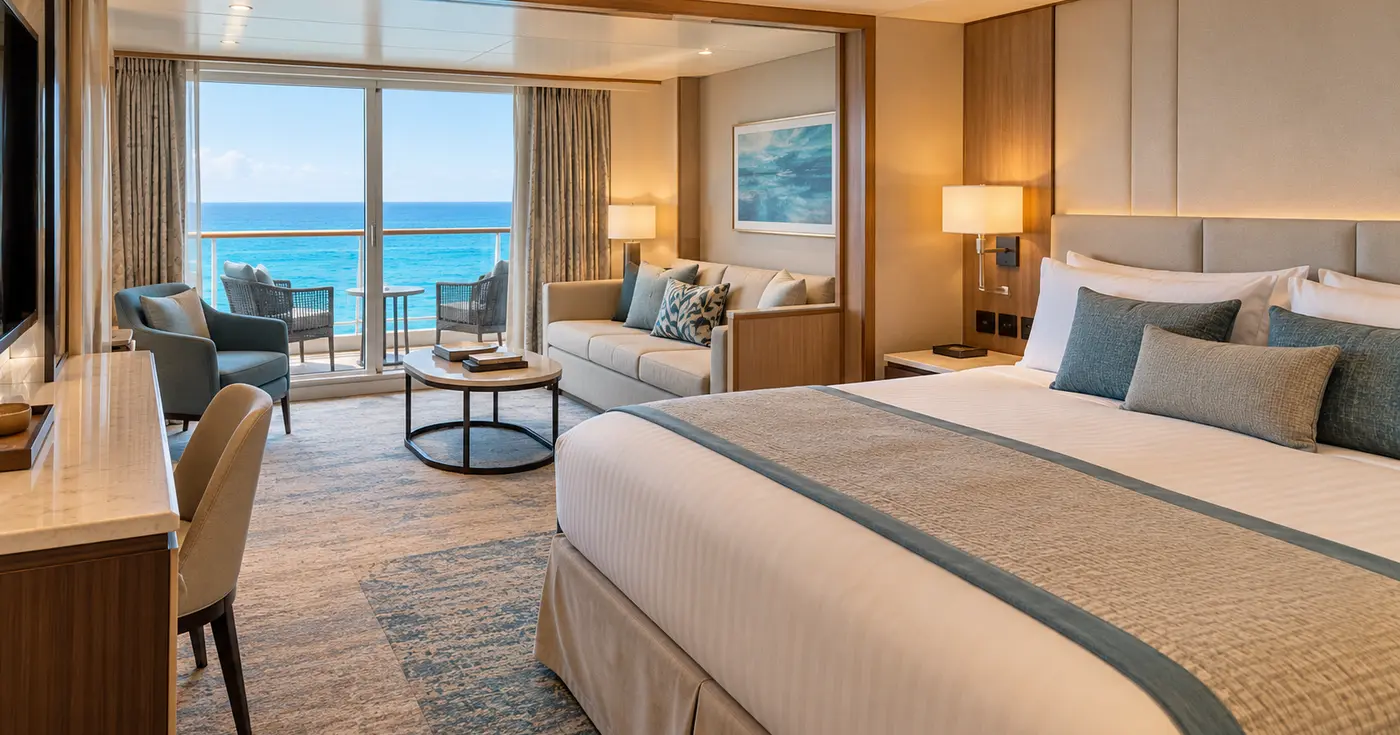
The suite door opens, and the upgrade becomes tangible: room to walk around the bed, a sofa that does not feel tucked into a passageway, and a balcony where everyone can sit without negotiating for the one open chair. Then the price difference appears, and the dreamy part of the decision gives way to a very practical question.
Is a cruise suite worth it—or would the same money create a better Caribbean vacation somewhere else?
The answer lives beyond square footage. On some ships, a suite is simply a larger, more comfortable cabin with priority boarding. On others, it changes where you eat, where you relax, who helps with reservations, and which packages are already in the fare. Before paying for the word suite, find out which of those experiences you are actually buying.
Quick Take
A cruise suite is worth it when you will use the extra room, private venues, concierge or butler service, and included packages enough to justify the total upgrade. It can be especially valuable for families sharing space, milestone trips, sea-day-heavy itineraries, and travelers who want a quieter ship-within-a-ship experience. Choose a balcony instead when port days dominate, the perks duplicate benefits you already have, or the premium would crowd out the experiences you value more.
“Suite” Is a Room Type, Not a Universal Promise
Cruise lines use the word suite for products that range from a slightly roomier cabin with a better bathroom to a two-story residence with several bedrooms and a long list of included services. Even within one fleet, benefits can change by ship, suite category, sailing date, and fare.
Royal Caribbean makes that difference unusually visible through its Sea, Sky, and Star tiers on eligible ships. Its current Royal Suite Class benefit chart gives Sea Class priority boarding and limited Coastal Kitchen access, while Sky adds benefits such as concierge service, a suite lounge or sun deck, priority arrangements, and internet in eligible categories. Star Class goes much further with a Royal Genie, most specialty dining, beverage packages, internet, standard gratuities, and other services. A Junior Suite and an Ultimate Family Townhouse may both sound like suite upgrades, but they do not buy the same vacation.
That is the first rule of suite shopping: ignore the category name for a moment and read the benefit list attached to the exact ship and room code.
Decide Which Kind of Upgrade You Want
The easiest way to evaluate a Caribbean cruise suite is to separate its value into four parts: space, access, service, and inclusions. You may care deeply about one and barely notice another.
Space can change how a family travels
Extra room is the most obvious benefit, but useful space matters more than the square-foot total. A separate bedroom can let adults stay awake after children go to sleep. A second bathroom can transform a family’s morning. A real dining table, larger closet, or balcony that seats the whole party may make the cabin feel like part of the vacation rather than a place everyone takes turns using.
Check the floor plan carefully. “Sleeps six” may include sofa beds or pull-down berths, one bathroom can still create a morning traffic jam, and an open loft may not provide acoustic privacy. Two nearby cabins can give adult travelers more doors, beds, bathrooms, and personal space than one glamorous suite. Price both arrangements for the actual party rather than comparing advertised per-person rates.
Private access can be more valuable than the room
For some travelers, the real upgrade begins after they leave the cabin. Norwegian’s Haven experience includes a concierge and 24-hour butler, escorted priority embarkation and disembarkation, and access to private Haven spaces. On ships equipped with them, that can include a restaurant, lounge, courtyard, pool, hot tubs, and sundeck. Norwegian also notes that some facilities and services are ship-specific, which is why a Haven comparison should begin with the exact vessel rather than a fleetwide photo gallery.
MSC Yacht Club follows a similar ship-within-a-ship idea. Its current Yacht Club description includes a private restaurant, Top Sail Lounge, sundeck, 24-hour butler and concierge service, premium drinks, Wi-Fi, and thermal-area access. Those private spaces can feel particularly valuable on a large Caribbean ship when the main pool deck is busiest.
If you picture quiet breakfasts, a less crowded place to read, and a familiar service team, enclave access may earn more of the premium than the room itself. If you expect to spend every day at the waterslides, shows, public restaurants, and ports, you may be paying for a retreat you rarely visit.
Service helps most when you know how you want to use it
A good concierge or butler can help arrange dining, entertainment, shore plans, and special requests. That is meaningful when coordinating a family group or celebration, but less valuable when you prefer to make your own reservations.
Service is also not magic. Popular venues can still have capacity limits, and a suite does not turn every request into a guarantee. On Royal Caribbean, the Royal Genie is a Star Class benefit and does not extend to friends or family staying outside Star Class. Celebrity likewise states that guests in an adjoining non-suite cabin do not gain access to The Retreat simply because they are traveling with suite guests.
Book the room configuration for everyone you want included. Otherwise, the suite can accidentally divide a group at the lounge, restaurant, or private deck.
Inclusions can narrow the real price gap
An expensive suite can sometimes replace purchases you already planned to make. Celebrity’s current Retreat inclusions combine every suite with Luminae, a Retreat lounge, butler and team service, Premium Drinks, and Premium Wi-Fi; Retreat sundecks are available on Edge Series and revolutionized ships. On Royal Caribbean, Star Class includes far more than Sea Class. MSC Yacht Club includes packages that a standard-cabin traveler might otherwise add separately.
Do not assign full retail value to every perk merely because it is listed. A beverage package is not a savings if you would not have bought it. Specialty dining has little value if you prefer the included restaurants. Wi-Fi for every traveler may be useful to one family and nearly irrelevant to another.
The reverse mistake is assuming every suite is highly inclusive. Princess says its Reserve Collection gives eligible mini-suites and suites dedicated Reserve dining and priority benefits, but only full suites receive certain extras such as the concierge lounge and private-venue breakfast where available. Princess also states that a Premier package is not included merely because a room is in Reserve Collection. Carnival’s priority guidance identifies priority check-in for eligible deluxe-suite guests, but that is a different proposition from a private-enclave product.
When a Suite Often Feels Worth the Money
Suites make their strongest case when the room solves a real problem or the suite complex matches the way you already want to vacation. A family may value a second bedroom or bathroom; a couple celebrating an anniversary may want the room, dining, and service to be central to the trip. Several sea days also create time to use the balcony, private venues, and attentive service.
The itinerary matters. A Florida round trip to the Southern Caribbean may include several sea days around the islands, giving the suite time to become a destination. Our Aruba, Bonaire, and Curaçao cruise guide shows the other side of that equation: three active island days in succession can leave even a beautiful room empty through most of the daylight hours.
When the Smarter Upgrade Is No Suite at All
If your Caribbean week revolves around early excursions, long beach days, late dinners, and shows, you may use the cabin mainly to shower and sleep. More space is pleasant, but a pleasant room that sits empty is not automatically the best place for the budget.
A balcony can be the sensible middle ground: private outdoor space and natural light without paying for services or restricted venues. Our guide to whether a Caribbean cruise balcony is worth it helps compare that value against an ocean-view or interior cabin.
The suite may also lose when its premium competes with the parts of travel that remove stress. Convenient flights, a hotel before embarkation, travel protection, excursions, or a longer sailing can improve the vacation more than a larger room. The guide to Caribbean cruise costs beyond the fare can keep the cabin decision inside the complete trip budget. An upgrade should make the vacation easier, not create benefits you feel obligated to use.
Price the Suite Like a Vacation, Not a Cabin
Start with the final booking totals for the suite and the best non-suite room you would genuinely accept. Use the same sailing, travelers, refundable conditions, and insurance assumptions. Then add the purchases that are not already included: gratuities or service charges, drinks, Wi-Fi, specialty dining, and anything else you expect to buy.
From there, credit the suite only for benefits you would have purchased anyway. The useful comparison looks like this:
Suite premium minus genuinely replaced purchases = the amount you are paying for added space, access, and service.
Divide that remaining number by the nights, then ask how often the travelers will use the space, private venues, priority arrangements, and service. Also compare two cabins, especially for families with older children or groups of adults; a connected balcony pair can fit better than one open-plan suite.
Read the Fine Print Before Falling for the Photos
Before paying a nonrefundable deposit, verify the exact category code and current benefits in writing. Ask whether the room has a true separate bedroom, how many bathrooms and real beds it provides, which guests receive the benefits, and whether the private restaurant, lounge, pool, or sundeck exists on that ship.
Check the deck plan above and below the suite. Large cabins can sit under pool decks, restaurants, gyms, or other active spaces. Forward and high-deck locations may experience more motion than a lower, more central cabin. A dramatic balcony may also be windy while the ship is moving, and furniture, shade, and privacy can differ from the marketing image.
Review the exclusions too. Specialty venues, premium menu items, minibar purchases, spa treatments, excursions, and gratuities may still cost extra. Save the terms connected to your booking instead of relying on a general web page months later.
If you are still choosing the line and ship, our Royal Caribbean versus Norwegian guide explains why comparing exact vessels and current inclusions is more useful than relying on brand stereotypes. First-time cruisers can also begin with the first Caribbean cruise guide before deciding how much of the budget belongs in the cabin.
So, Is a Cruise Suite Worth It?
Yes—when the suite changes the parts of the vacation your travelers care about most. It may give a family the space to enjoy living together for a week, create a quiet refuge inside a lively ship, wrap useful packages into one fare, or make a long-awaited celebration feel wonderfully easy.
But the word suite is not the value. The value is the exact room, access, service, and inclusions on the exact ship, measured against what you would otherwise buy. If those benefits sound like your vacation, the upgrade can be memorable every day. If the Caribbean ports are the real priority, book the simpler cabin confidently and spend where the adventure is happening.
Tell CPosey Travel who is traveling and what you want the week to feel like. We can compare the suite, balcony, and multi-cabin options side by side—including the benefits and likely extras—so the upgrade earns its place in the vacation.